


Open the chart wider than A1C
At the first medication visit, several questions arrive together. Does the patient have established or high-risk ASCVD? Heart failure? CKD? What are the glycemic and weight goals? Which adverse effects and administration burdens are acceptable? Can the patient obtain the medication next month as well as today?
Metformin remains effective, inexpensive, widely available, weight neutral, and unlikely to cause hypoglycemia by itself. Those strengths support its use as an initial or concurrent therapy for many adults. Other clinical findings can give the opening plan an additional job: reducing cardiovascular events, preventing heart-failure hospitalization, or slowing CKD progression.
The first decision is which problem the opening plan must solve.
The 2026 ADA pharmacotherapy section treats that as a shared-decision question. Recommendation 9.5 places cardiovascular and kidney effects, weight, hypoglycemia, cost, access, adverse effects, tolerability, and patient preference in the same frame. This article uses that US guideline context; other jurisdictions sequence initial therapy differently.
Three findings can change the first priority
Start by looking for a more urgent branch. Recommendation 9.20 says to consider insulin when symptoms of hyperglycemia are present or when A1C is above 10% or glucose is at least 300 mg/dL. Catabolic symptoms, possible autoimmune diabetes, and hyperglycemic crisis require their own assessment.
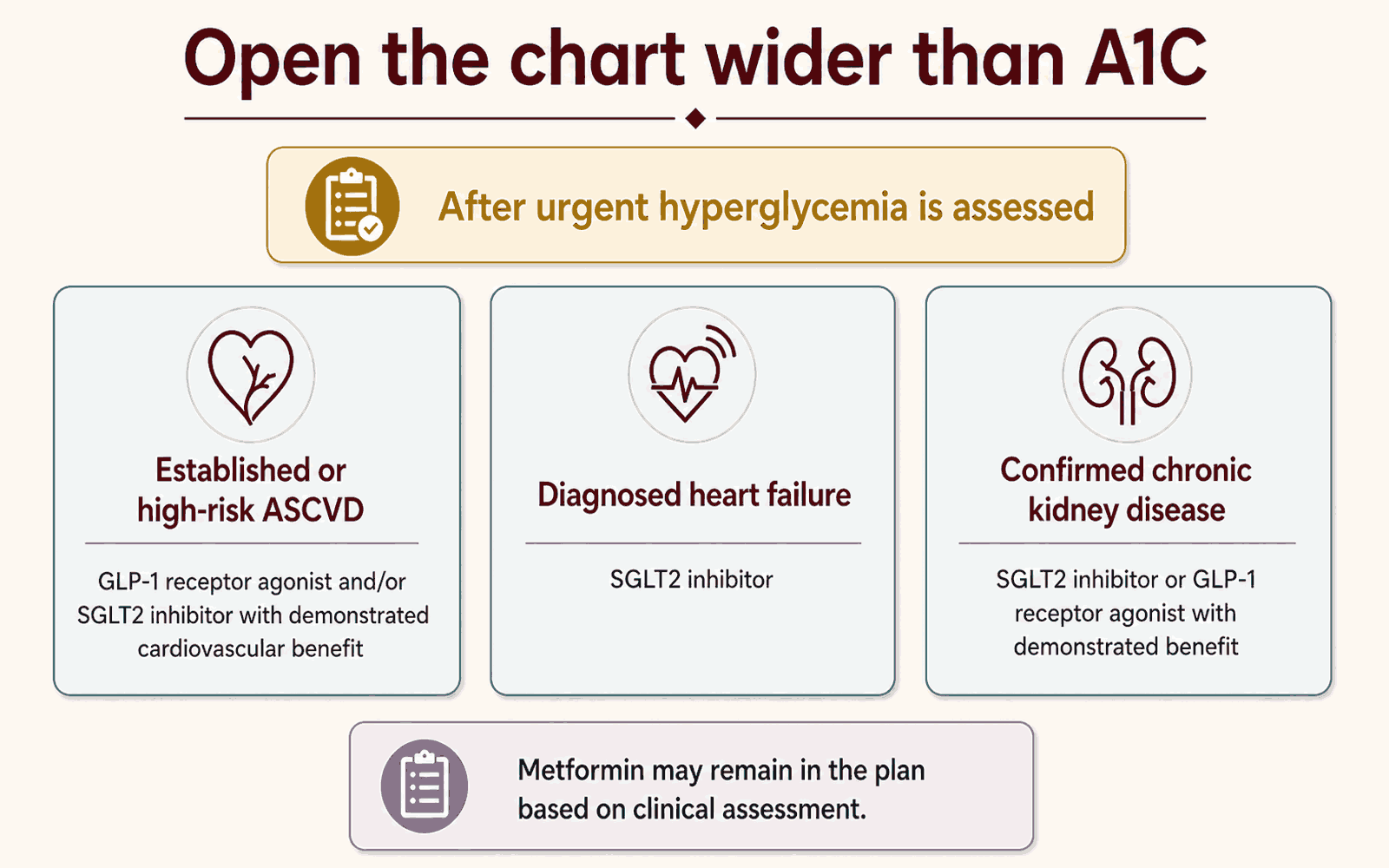
For adults outside that branch, three common findings carry distinct recommendations.
Established or high-risk ASCVD
Recommendation 9.7 says the treatment plan should include a GLP-1 receptor agonist and/or SGLT2 inhibitor with demonstrated cardiovascular benefit for adults with established or high-risk ASCVD, irrespective of A1C. The outcome evidence belongs to named agents and studied populations, so the class label alone is too broad for selection.
Heart failure
Recommendation 9.8 directs an SGLT2 inhibitor for adults with type 2 diabetes and heart failure with reduced or preserved ejection fraction. The stated purposes are glycemic management and prevention of heart-failure hospitalization, again irrespective of A1C. Separate recommendations address GLP-1-based therapy for people with obesity and symptomatic HFpEF.
Chronic kidney disease
Recommendation 9.10 covers confirmed CKD with eGFR 20–60 mL/min/1.73 m² and/or albuminuria. It calls for an SGLT2 inhibitor or GLP-1 receptor agonist with demonstrated benefit in that population; it does not require combination therapy. Combination evidence is addressed separately and remains incomplete. Advanced CKD has another branch: below an eGFR of 30, Recommendation 9.11 prefers a GLP-1 receptor agonist for glycemic management, lower hypoglycemia risk, and cardiovascular-event reduction.
The phrase “should include” establishes a treatment priority while preserving room for combination therapy and person-centered sequencing. Metformin may remain in the plan. The outcome-directed indication proceeds at any A1C, while glycemic goals remain active.
Outcome trials expanded the treatment goal
The modern algorithm grew from trials that measured clinical outcomes beyond glucose lowering.
EMPA-REG OUTCOME randomized 7,020 adults with type 2 diabetes and established cardiovascular disease to empagliflozin or placebo on top of standard care. Over a median observation period of 3.1 years, the primary cardiovascular composite occurred in 10.5% of the empagliflozin group and 12.1% of the placebo group. Cardiovascular death occurred in 3.7% versus 5.9%, and heart-failure hospitalization in 2.7% versus 4.1%. Myocardial infarction and stroke did not differ significantly.
FLOW randomized 3,533 adults with type 2 diabetes and CKD to semaglutide or placebo. During a median 3.4 years, the primary composite of kidney failure, a sustained eGFR decline of at least 50%, or kidney or cardiovascular death occurred in 331 participants receiving semaglutide and 410 receiving placebo (HR 0.76, 95% CI 0.66–0.88).
Both were manufacturer-funded randomized outcome trials in defined higher-risk populations. Their value comes from the populations, comparators, endpoints, and absolute events as well as the relative estimates. They support selecting agents for demonstrated outcomes. Molecular mechanism, class-wide transfer, and optimal sequencing remain open questions.
“Irrespective of A1C” removes A1C as a gate for these outcome indications. The phrase describes a treatment threshold; mechanism remains unresolved and glycemic control remains clinically relevant.
Where metformin remains a strong starting option
Section 9 describes metformin as a common medication that historically has been first-line when routine glucose lowering is the leading clinical need. It is effective, safe, inexpensive, and widely available. Compared with sulfonylureas, it offers useful A1C lowering, weight neutrality, and little intrinsic hypoglycemia risk.
Much of its long-term outcome reputation traces to UKPDS 34. The study identified 1,704 overweight adults with newly diagnosed type 2 diabetes, then included 753 in the primary randomized comparison of metformin with conventional management, primarily diet. Over a median 10.7 years, metformin allocation was associated with lower diabetes-related endpoints and mortality.
That result remains clinically important. Its boundaries matter too. The participants entered between 1977 and 1991, the randomized metformin comparison was small beside a modern cardiovascular outcome trial, and background risk-factor care has changed. Direct comparisons with current SGLT2 inhibitors or GLP-1 receptor agonists are absent. A 2017 meta-analysis of randomized metformin trials found imprecise estimates for all-cause mortality, cardiovascular death, and myocardial infarction. Contemporary head-to-head hard-outcome evidence remains an open gap.
For patients free of ASCVD, heart failure, and CKD, selection still turns on weight goals, MASH, hypoglycemia risk, kidney function, tolerability, access, and preference. Those factors can favor another or an additional agent. When A1C is at least 1.5 percentage points above the individualized goal, Section 9 notes that many people will need dual therapy or a more potent option.
Metformin and an outcome-directed drug can begin together or be used concurrently. Each medication in the plan should have a stated role.
Keep metformin’s safety work visible
GI effects are common enough to change adherence. Gradual titration, taking the medication with food, and an extended-release formulation can reduce bloating, abdominal discomfort, diarrhea, and nausea.
Kidney function needs a precise plan. Current US extended-release labeling requires eGFR assessment before treatment and periodically afterward. Initiation is not recommended at eGFR 30–45 mL/min/1.73 m². Continued use should be reassessed if eGFR later falls below 45, and the drug is contraindicated below 30.
The same label gives targeted iodinated-contrast instructions. It calls for temporary interruption when eGFR is 30–60, when there is a history of liver disease, alcoholism, or heart failure, or when intra-arterial contrast is planned, followed by an eGFR check after 48 hours before restarting. Restricted food and fluid intake around a procedure, acute kidney injury, hypoxia, and unstable illness also belong in the hold decision. ADA 2026 Section 10 says metformin may continue in stable heart failure when eGFR remains above 30 and should be avoided in unstable or hospitalized heart failure.
Metformin-associated lactic acidosis is rare, but the risk becomes clinically important with substantial renal impairment, acute hypoxic states, hepatic impairment, excessive alcohol use, and selected procedures or interacting drugs.
Long-term therapy also carries a vitamin B12 signal. ADA Recommendation 3.10 calls for periodic B12 assessment, especially with anemia or peripheral neuropathy. The current extended-release label recommends annual hematologic parameters and B12 measurement every two to three years.
A preferred therapy must become an executable plan
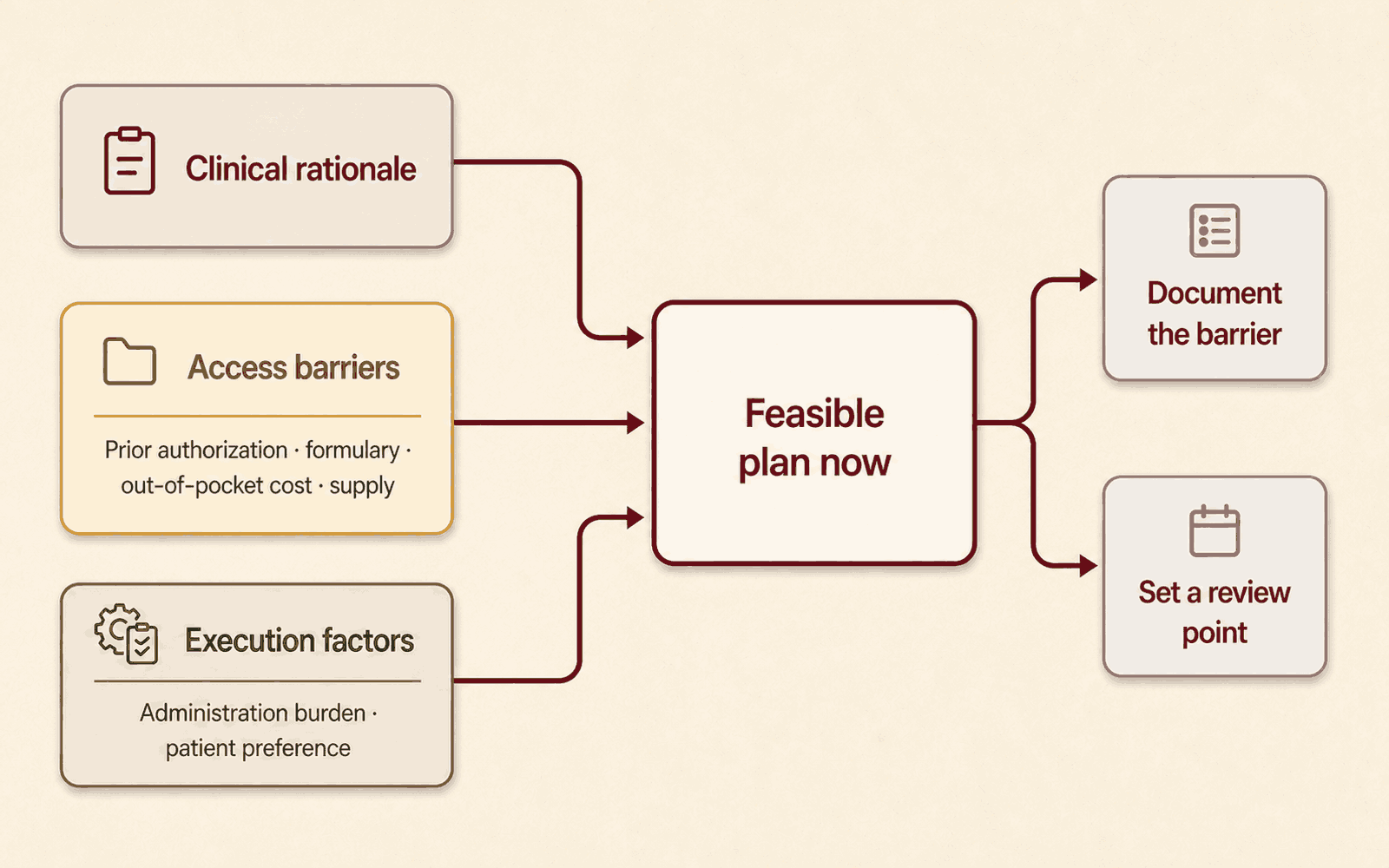
The evidence-preferred drug can still meet a prior authorization, a nonpreferred formulary tier, an unaffordable copay, a supply problem, an administration burden, or a patient preference that changes execution.
ADA Recommendations 9.29 and 9.30 make financial obstacles part of routine assessment. They allow lower-cost agents, including metformin, while asking clinicians to keep hypoglycemia, weight, cardiovascular and kidney outcomes, and other adverse effects visible.
List price, wholesale acquisition cost, a payer’s negotiated net price, and the amount a patient owes are different numbers. A real-time benefit check reveals the last one. A useful chart records the evidence-preferred therapy, the access barrier, the feasible plan, and when the team will revisit the gap.
Reconcile the regimen and set the review point
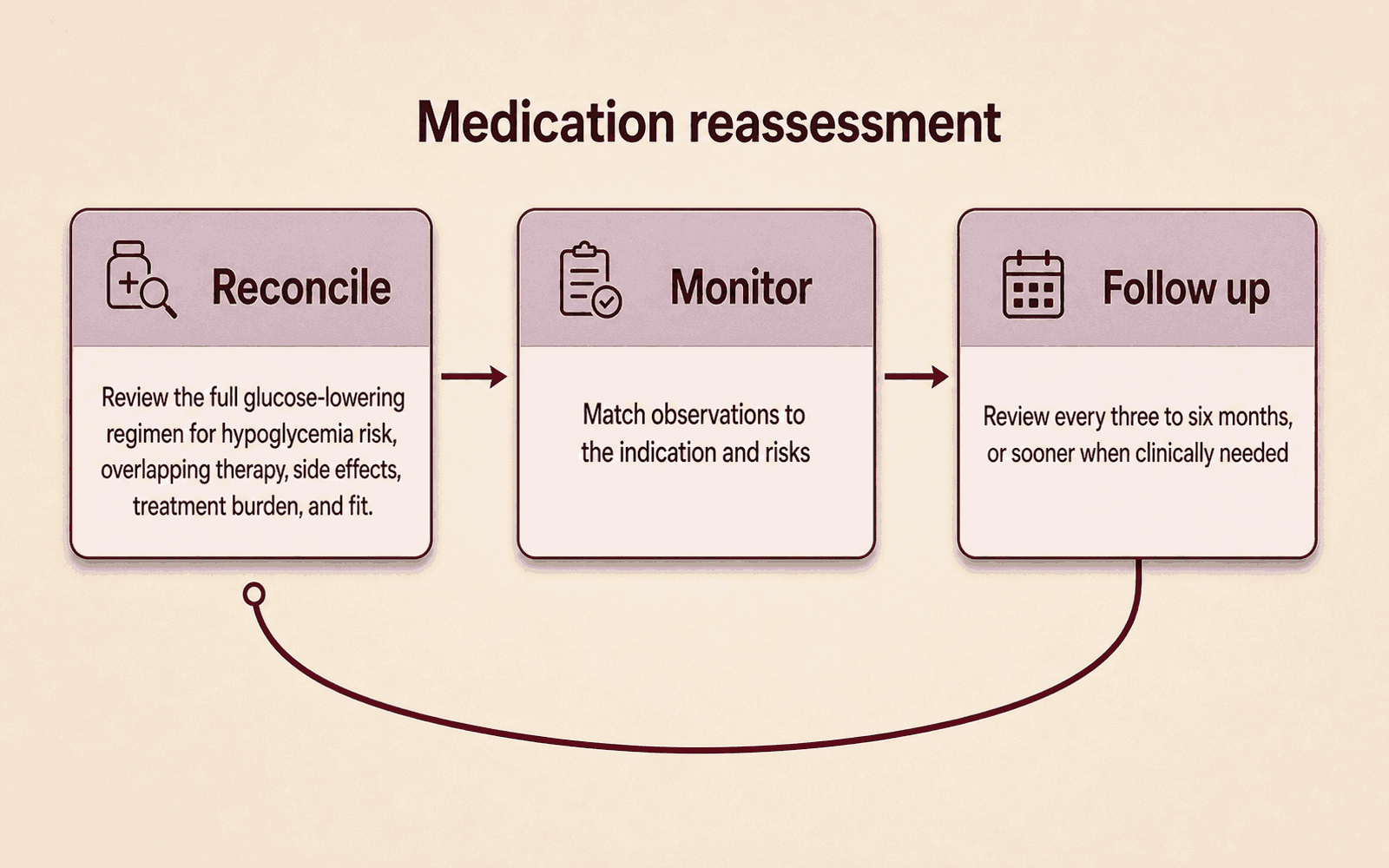
Recommendation 9.17 links initiation of a new glucose-lowering medication to reassessment of the need for and dose of sulfonylureas, meglitinides, and insulin. The intended endpoints are lower hypoglycemia risk and treatment burden. Automatic discontinuation or dose reduction would exceed the recommendation.
Recommendation 9.18 addresses a different issue. Concurrent DPP-4 inhibitor and GLP-1-based therapy is not recommended because the combination adds no glucose lowering.
Set the reassessment point at the same visit. Section 9 calls for medication and medication-taking review every three to six months, with earlier follow-up when symptoms, hypoglycemia, titration, kidney function, access, or severe hyperglycemia require it. Match the observation to the indication: A1C and glucose patterns, weight, heart-failure symptoms and events, kidney measures, adverse effects, B12 risk, medication burden, and whether the patient could obtain the drug.
Explain the reason in one minute
A patient-facing explanation can stay brief:
“Your A1C tells us about average glucose. Your heart and kidney history tell us which medicines may lower the chance of heart and kidney complications. We are choosing a plan that addresses both, and we will also make sure it is tolerable and obtainable.”
At the next handoff, another clinician should be able to see the same logic: the priority being treated, why this agent was selected, whether metformin has a role, which existing medicines were reviewed, any access constraint, and the date and measures for reassessment. That documentation is more durable than calling one drug the default.
Selected sources and further reading
- ADA Standards of Care 2026: pharmacologic approaches to glycemic treatment
- ADA/EASD 2022 consensus report on type 2 diabetes management
- Current US metformin extended-release labeling
- UKPDS 34: randomized metformin comparison
- Randomized-trial meta-analysis of metformin and cardiovascular outcomes
- EMPA-REG OUTCOME
- FLOW kidney-outcomes trial
- ADA 2026: periodic vitamin B12 assessment with long-term metformin
This article is for professional education and does not replace patient- specific prescribing, current product labeling, or local policy.