


Start with four details
A pharmacy message that says “Coverage denied” almost never says why.
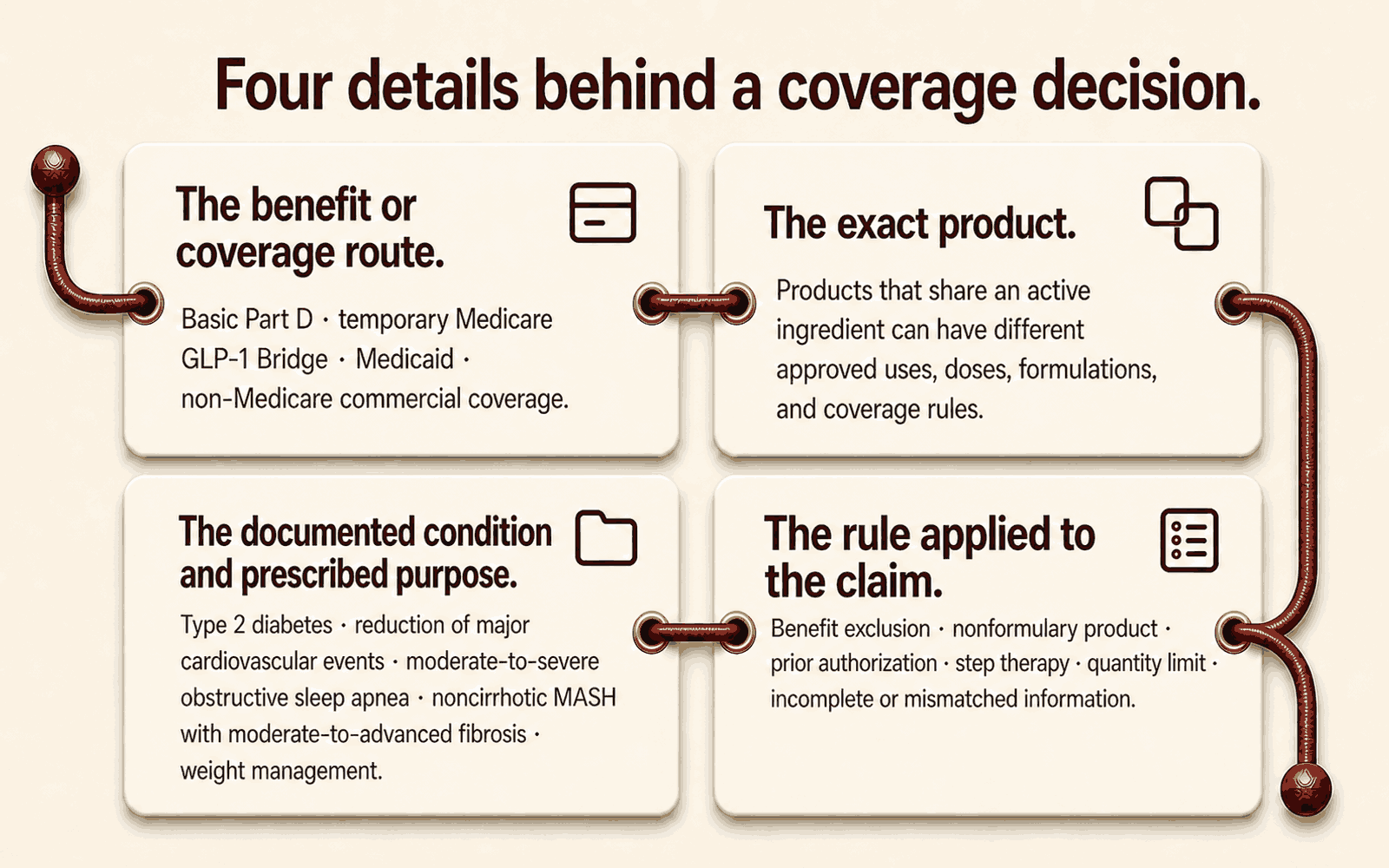
The next step depends on four details:
- Your insurance benefit. Medicare Part D, the temporary Medicare GLP-1 Bridge, Medicaid, and non-Medicare employer or individual commercial plans use different rules.
- The exact product. Ozempic and Wegovy both contain semaglutide, and Mounjaro and Zepbound both contain tirzepatide, yet each product has its own FDA-approved uses and its own place in a plan’s coverage rules.
- The condition being treated. A prescription for type 2 diabetes, cardiovascular-risk reduction, obstructive sleep apnea, liver disease, or weight management may enter a different coverage route.
- The rule that stopped the claim. A benefit exclusion, nonformulary drug, prior authorization, step-therapy rule, quantity limit, or incomplete record calls for a different response.
Those details turn one vague denial into a specific administrative problem. They also prevent wasted appeals and unsafe workarounds.
One active ingredient can enter coverage through different products
Semaglutide is the active ingredient in Ozempic and Wegovy. Ozempic’s current US label includes three uses:
- blood-glucose control in adults with type 2 diabetes;
- reduction of cardiovascular death, nonfatal heart attack, or nonfatal stroke in adults with type 2 diabetes and established cardiovascular disease; and
- reduction of sustained kidney-function decline, end-stage kidney disease, or cardiovascular death in adults with type 2 diabetes and chronic kidney disease.
Wegovy has separate labeled uses, including long-term weight reduction and cardiovascular-risk reduction in adults with established cardiovascular disease and overweight or obesity.
The same pattern appears with tirzepatide. Mounjaro is labeled, alongside diet and exercise, to improve blood glucose in adults and children age 10 or older with type 2 diabetes. Zepbound is labeled for long-term weight reduction and for moderate-to-severe obstructive sleep apnea in adults with obesity.
In a coverage decision, the label, formulation, dose, prescribed use, and place on the plan’s covered-drug list, often called its formulary, all travel with the product name.
In the SELECT trial, 17,604 adults had established cardiovascular disease and overweight or obesity without diabetes. The trial’s primary combined outcome was cardiovascular death, nonfatal heart attack, or nonfatal stroke. It occurred in 6.5% of participants assigned semaglutide 2.4 mg and 8.0% assigned placebo over a mean follow-up of 39.8 months. The hazard ratio was 0.80, commonly described as about a 20% lower hazard; the absolute event-rate difference was 1.5 percentage points. The FDA added a cardiovascular-risk-reduction indication to Wegovy for that defined population in 2024.
That approval gives the use a route into Medicare Part D and other coverage reviews. It does not place every GLP-1 product, cardiovascular condition, or plan under one class-wide rule.
Medicare has two distinct routes in 2026
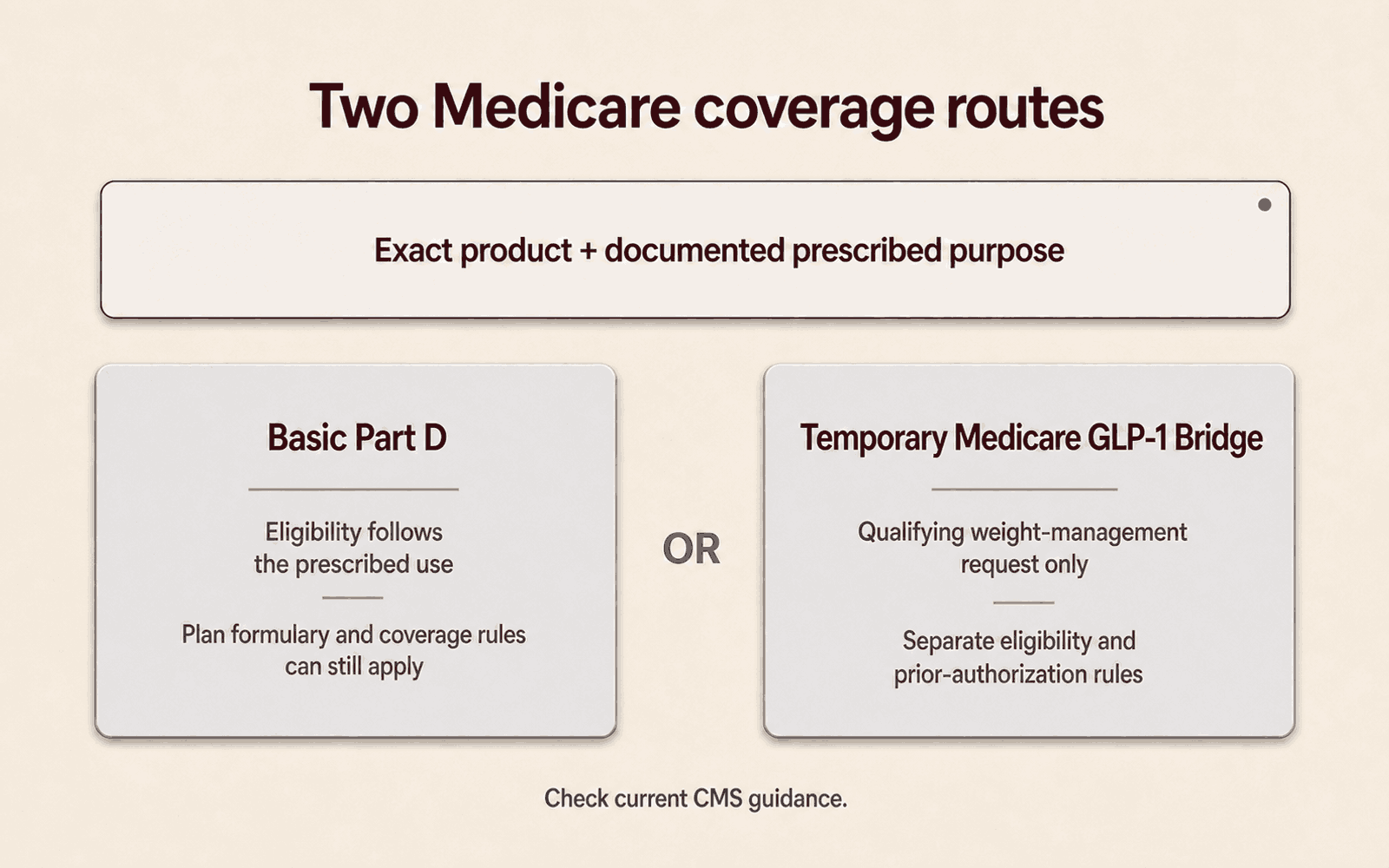
Medicare’s ordinary Part D route and the temporary Medicare GLP-1 Bridge now sit beside each other. They solve different coverage questions.
Basic Part D follows the prescribed use
The current Part D statute points to a Medicaid list of drugs and medical uses that may be excluded. That list includes agents “when used for anorexia, weight loss, or weight gain.” As a result, a weight-loss use sits outside the basic Part D drug benefit under the current interpretation.
The exclusion follows the prescribed use rather than the GLP-1 class or active ingredient. Some enhanced Part D plans can add these drugs as an extra benefit outside the basic package. A blanket statement that Medicare plans are forbidden to cover them is therefore too broad.
A product prescribed for a different FDA-approved indication can be eligible for ordinary Part D coverage. CMS currently identifies routes that include type 2 diabetes, moderate-to-severe obstructive sleep apnea, noncirrhotic MASH with moderate-to-advanced fibrosis, a form of liver disease with scarring, and reduction of major cardiovascular events. Every route remains product- and population-specific. The plan may still apply its covered-drug list, prior authorization, step therapy, or quantity rules.
The Medicare GLP-1 Bridge covers a weight-management route
On July 1, 2026, CMS launched the Medicare GLP-1 Bridge. It is a nationwide, temporary demonstration for eligible people enrolled in qualifying Part D plan types. It runs through December 31, 2027 and operates outside the Part D benefit’s coverage and payment flow. In 2026, a single central processor handles Bridge prior authorization, claims, and pharmacy payment.
The Bridge requires prior authorization. At the time GLP-1 therapy began, an adult must have met one of three clinical paths:
- BMI of at least 35;
- BMI of at least 30 plus heart failure with preserved ejection fraction, uncontrolled hypertension despite two medicines, or chronic kidney disease stage 3a or higher; or
- BMI of at least 27 plus prediabetes, a previous heart attack, a previous stroke, or symptomatic peripheral artery disease.
Meeting a BMI path is only one part of eligibility. CMS says a person with type 2 diabetes, moderate-to-severe obstructive sleep apnea, or noncirrhotic MASH with moderate-to-advanced liver scarring is ineligible for the Bridge, even if they meet a BMI path and their Part D plan does not cover a GLP-1 for that condition. Those requests go to Part D. Bridge eligibility can still be possible for a person with established cardiovascular disease when the prescription is solely for weight management. Any prescription intended to reduce major cardiovascular events goes to Part D, including one that also lists weight management as a purpose.
For 2026, CMS also excludes anyone who received a GLP-1 paid for by Part D during calendar year 2026. CMS has not yet set the lookback period it will use in 2027.
The Bridge prescription must be for reducing and maintaining weight along with ongoing structured nutrition and physical activity consistent with the product’s label, unless physical activity is not clinically appropriate. CMS maintains a current product and eligibility list because the products can change during the demonstration.
A person who qualifies pays $50 per month. The Part D deductible does not apply, the payment does not count toward Part D out-of-pocket spending, and Extra Help does not reduce it.
Product, purpose, diagnoses, prior Part D use, and the other eligibility rules together determine the route. A prescription for a use eligible for Part D goes to the Part D plan, even when the product is missing from that plan’s covered-drug list. A weight-management prescription may go to the Bridge only when every Bridge criterion is met and no disqualifier applies.
The appeal paths differ too. A Part D decision can enter the coverage determination, exception, or appeal process. The Bridge has no formal appeal process. A prescriber can submit a corrected request or add new information after a Bridge denial.
| Basic Part D | Medicare GLP-1 Bridge | |
|---|---|---|
| Covers | A product prescribed for a use eligible for Part D, subject to the plan’s formulary and coverage rules | A qualifying weight-management prescription only |
| Cost | The plan’s deductible and cost sharing | $50 per month, outside the Part D deductible and out-of-pocket totals |
| After a denial | Coverage determination, formulary exception, or appeal | No formal appeal; the prescriber can resubmit corrected or added information |
| Timeframe | Ongoing Part D benefit | Temporary demonstration through December 31, 2027 |
Medicaid and commercial plans write their own coverage rules
Medicaid follows a different federal rule. Federal law allows a state to exclude or restrict drugs when used for weight loss, which means coverage varies by state and program. CMS’s BALANCE model offers a voluntary path for participating states and manufacturers. A state’s participation still does not guarantee coverage for every person or product.
Non-Medicare employer, union, Marketplace, and other commercial plans sit in another category. Medicare’s Part D statute does not control those benefits. An employer may include or exclude weight-management medicine, an insurer may set a formulary, and a pharmacy-benefit manager may administer prior authorization or step therapy.
Some employer and union retiree drug benefits are Medicare Part D employer-group plans, often called EGWPs. CMS lists EGWPs among the plan types eligible for the Bridge. If an employer or union sponsors your drug coverage, ask whether it is a Part D plan before applying commercial-plan rules. The current plan document and written denial are better guides than a neighbor’s approval or a broad statement about “insurance.”
If Medicaid or commercial coverage is unclear, ask for the section of the benefit document or clinical policy that supports the decision. The exact language will reveal whether an exception or appeal exists.
Name the denial before building the response
Several denials can look identical at the pharmacy counter:
- Benefit exclusion: the plan does not include the prescribed use in the purchased benefit.
- Nonformulary product: the benefit covers the type of treatment, while the exact product is absent from the drug list.
- Prior authorization: the plan wants clinical information before it decides.
- Step therapy or quantity limit: the plan requires another covered option first or limits the amount it will cover. In type 2 diabetes, the required first option is often metformin.
- Incomplete or mismatched information: the prescription, authorization, claim, and clinical record do not describe the same product or actual indication.
A medical-necessity statement can support a formulary exception or appeal when the use belongs inside the benefit. It generally cannot create a benefit that the contract or statute excludes. Identify the denial reason before building the response.
Accurate documentation is also a safety and compliance issue. Records and diagnosis codes should describe the patient’s documented condition and the purpose for which the clinician is prescribing the product. Coverage navigation is never a reason to add a diagnosis, change the stated indication, or substitute a product on paper.
Bring a small packet to the next call
Start with the phone number on the denial or plan card. Keep the exact product and dose, written denial, and any relevant portal notes or records available to you within reach, then work through these questions:
- What is the exact reason and policy language? Ask for the denial in writing, including the name of the product and the benefit rule applied.
- Which coverage route is reviewing it? For Medicare, ask whether the request belongs with ordinary Part D or the Bridge. For Medicaid or a commercial plan, confirm the specific drug benefit and administrator.
- What alternatives and requirements are listed? Ask about covered products, prior-authorization criteria, step therapy, quantity limits, and the form the prescriber must complete.
- Does an exception or appeal exist? For a use eligible for Part D, Medicare allows a coverage determination, formulary exception, and appeal. Other plans must provide their own route and deadline. A Bridge denial uses corrected or additional information rather than an appeal.
- Could a delay create clinical urgency? Ask the prescriber and reviewing program whether an expedited review is appropriate. The Part D plan, other payer, or Bridge central processor, rather than the pharmacy counter, makes the formal coverage decision for its route.
Write down the date, representative, reference number, requested documents, and next deadline. A clinician or pharmacist can help reconcile the product, indication, prior treatment, contraindications, and covered alternatives. People with Medicare can also call 1-800-MEDICARE or use their local State Health Insurance Assistance Program (SHIP).

Protect the treatment plan while the paperwork moves
Coverage answers who will pay under a particular rule. Clinical suitability still depends on the exact product, medical history, current medicines, adverse effects, and goals.
Do not ration doses, stretch the interval, switch products, combine GLP-1 medicines, or change diabetes medicines without a prescriber-led plan. If coverage may interrupt treatment, contact the prescribing team and pharmacist before the next dose is due so they can discuss a safe transition, monitoring, and available alternatives.
Current product labels carry important boundaries, including the boxed thyroid C-cell-tumor warning and contraindications for a personal or family history of medullary thyroid carcinoma or multiple endocrine neoplasia type 2 (MEN2). They also address severe gastrointestinal effects, pancreatitis and gallbladder problems, and dehydration and acute kidney injury. The labels cover hypoglycemia when a GLP-1 is used with insulin or a medicine that prompts insulin release, such as a sulfonylurea. Pregnancy and procedures involving anesthesia or deep sedation appear on the labels as well. The details differ by product.
Use an FDA-approved product dispensed by a state-licensed pharmacy. The FDA warns that unapproved GLP-1 products have not gone through its review for safety, effectiveness, or quality and have been associated with dosing errors and other adverse events.
Under this benefit, this product for this condition was stopped by this rule. That sentence is what the care team needs from you. Once those four details are visible, the care team can choose the available route and keep the treatment plan clinically grounded while the coverage decision moves.
Selected official sources and further reading
- Current Medicare Part D statute
- Medicaid drug-coverage exclusion list
- Medicare GLP-1 Bridge patient information
- CMS Bridge eligibility, product, and routing guidance
- CMS BALANCE model
- Medicare Part D coverage determinations and appeals
- FDA: Wegovy cardiovascular-risk-reduction indication
- FDA: Zepbound obstructive-sleep-apnea indication
- SELECT cardiovascular-outcomes trial
- FDA concerns about unapproved GLP-1 products
This information is for education and reflects US policy reviewed on 2026-07-30. Coverage rules and program details can change. Discuss medication decisions with your care team and confirm current requirements with your plan.