


Six good ideas can feel like a second job
One appointment can leave you carrying a meal goal, a movement plan, a medication question, a sleep concern, and a new set of glucose readings. Each task asks for time and attention. Together, they can feel like a second job.
One of them has to go first.
Berine's six-pillar framework gives each concern a place. It also gives you a way to choose a starting point that fits the life, health needs, and resources you have right now. The framework widens the view while keeping the next decision manageable.
The map Berine uses
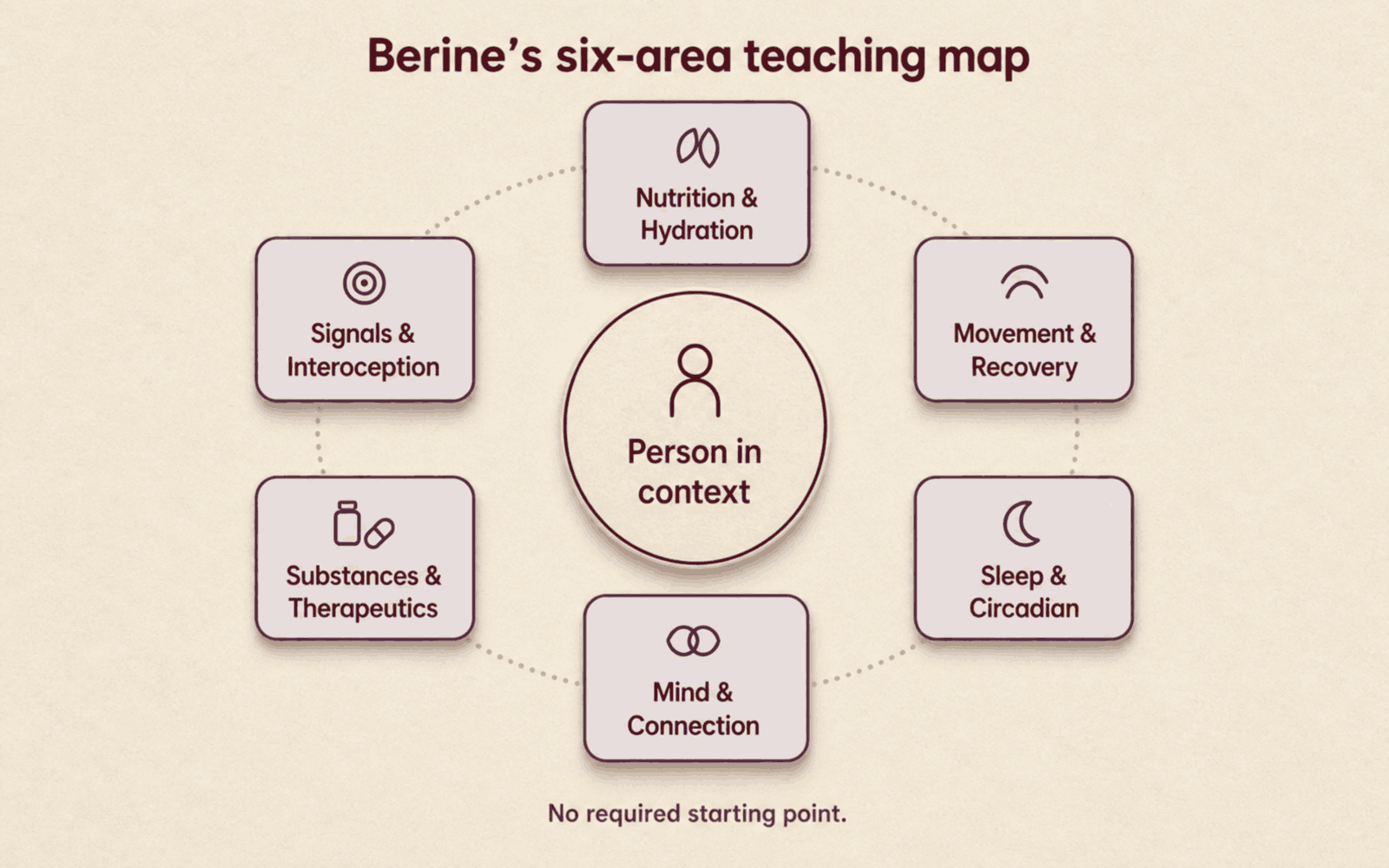
Berine organizes metabolic-health education into six paired domains. This is our teaching and decision map. Diagnostic criteria, treatment guidelines, and individual clinical assessment keep their separate roles.
Other organizations arrange whole-person care differently. The American College of Lifestyle Medicine uses six lifestyle pillars that include nutrition, physical activity, sleep, stress management, social connection, and risky-substance avoidance. Berine's map includes therapeutics and two kinds of bodily information because those subjects need a clear home in diabetes education. The exact number and pairings belong to Berine's framework.
Here are the six areas in everyday language:
Nutrition & Hydration covers eating patterns and fluid intake. Fluid needs change with health conditions, medicines, weather, activity, diet, and any limits set by a clinician. Extra water has a much thinner glucose-treatment evidence base than medical nutrition therapy.
Movement & Recovery includes daily movement, structured exercise, mobility, and the support that helps activity remain safe and sustainable. Recovery practices vary widely in purpose and evidence.
Sleep & Circadian brings together sleep duration and quality with the body's daily timing system. Light exposure, sleep-wake schedules, shift work, and meal timing can all enter the conversation.
Mind & Connection makes room for diabetes distress, mood, coping, relationships, belonging, and the social setting around care. Their effects on self-management and glucose differ from person to person.
Substances & Therapeutics includes prescribed treatment, supplements, caffeine, alcohol, nicotine, and other substances. Their purposes, doses, evidence, benefits, and risks differ, and medication decisions belong with the prescribing team.
Signals & Interoception separates external measurements, such as glucose readings and lab results, from internal bodily signals, such as hunger, thirst, fatigue, fullness, dizziness, or pain. Interoception is the nervous system's process for sensing and interpreting internal states. A measurement and a felt experience can inform the same conversation while offering different kinds of information.
Structural conditions cross the entire map. The useful first step may be a benefits call, an interpreter, a safer movement option, a medication review, transportation help, a food-access resource, or a family conversation. The importance of a domain says very little about how much control one person has over it.
Choosing one primary question for now is a planning decision. The other five areas remain available as context. A medication-access problem may be primary while sleep and stress stay visible in the background. Keeping one primary question protects the week from becoming six simultaneous experiments and makes the review easier to interpret.
Connections worth observing
Two domains can share physiology. One action can also affect several measured outcomes. Behavioral spillover asks a different question: after someone changes one behavior, does an untargeted behavior change too?
A review of 106 behavioral-spillover studies found several possible directions. One behavior may encourage another, give someone permission to ease up elsewhere, trigger a compensating action, or leave a neighboring behavior unchanged. A 2024 review of trials that deliberately targeted several health behaviors supports multidomain programs. Spontaneous positive spillover remains a separate and less settled question.
That boundary changes how we talk about hydration. A fixed sequence of more water, less fatigue, less caffeine, and better sleep may describe one person's experience. Evidence does not support presenting it as the expected path for everyone. Our hydration guide explains why fluid needs and glucose effects require more context.
Caffeine and sleep make a narrower case. A meta-analysis of 24 controlled studies found that caffeine shortened total sleep by about 45 minutes on average and changed sleep efficiency, sleep onset, and time awake during the night. Dose, timing, and individual sensitivity all matter. Someone who notices late coffee and short sleep on workdays has a reasonable pattern to examine. They still need to observe what happens rather than assume the next link in a chain.
Two people can use the same map from very different places. One may choose caffeine timing because it fits the workday and the current sleep question. Another may start with medication access because a refill gap is shaping glucose readings and daily stress. Their paths can cross several domains while leaving several untouched.

Safety sets the order
Some situations move to the front immediately. Treat a current low glucose according to the plan you received from your care team. The 2026 ADA Standards say that one or more episodes of level 2 or level 3 hypoglycemia should prompt reevaluation of the treatment plan. Recurrent lows deserve prompt contact with the prescribing team.
Persistently sleeping only a few hours or feeling dangerously sleepy during the day deserves prompt contact with your care team. The ADA recommends screening sleep health in people with diabetes and referring when indicated. Individual clinical circumstances shape any sleep plan, and for healthy adults, the American Academy of Sleep Medicine recommends seven or more hours regularly. If you are too sleepy to drive safely, delay the trip or use another ride. NHTSA's drowsy driving guidance explains why coffee offers limited protection during serious sleep loss.
Prescribed medication changes, insulin adjustments, urgent-symptom plans, and clinician-directed fluid limits stay inside the care-team relationship. A general framework yields to the safety plan.
Build a first step you can review
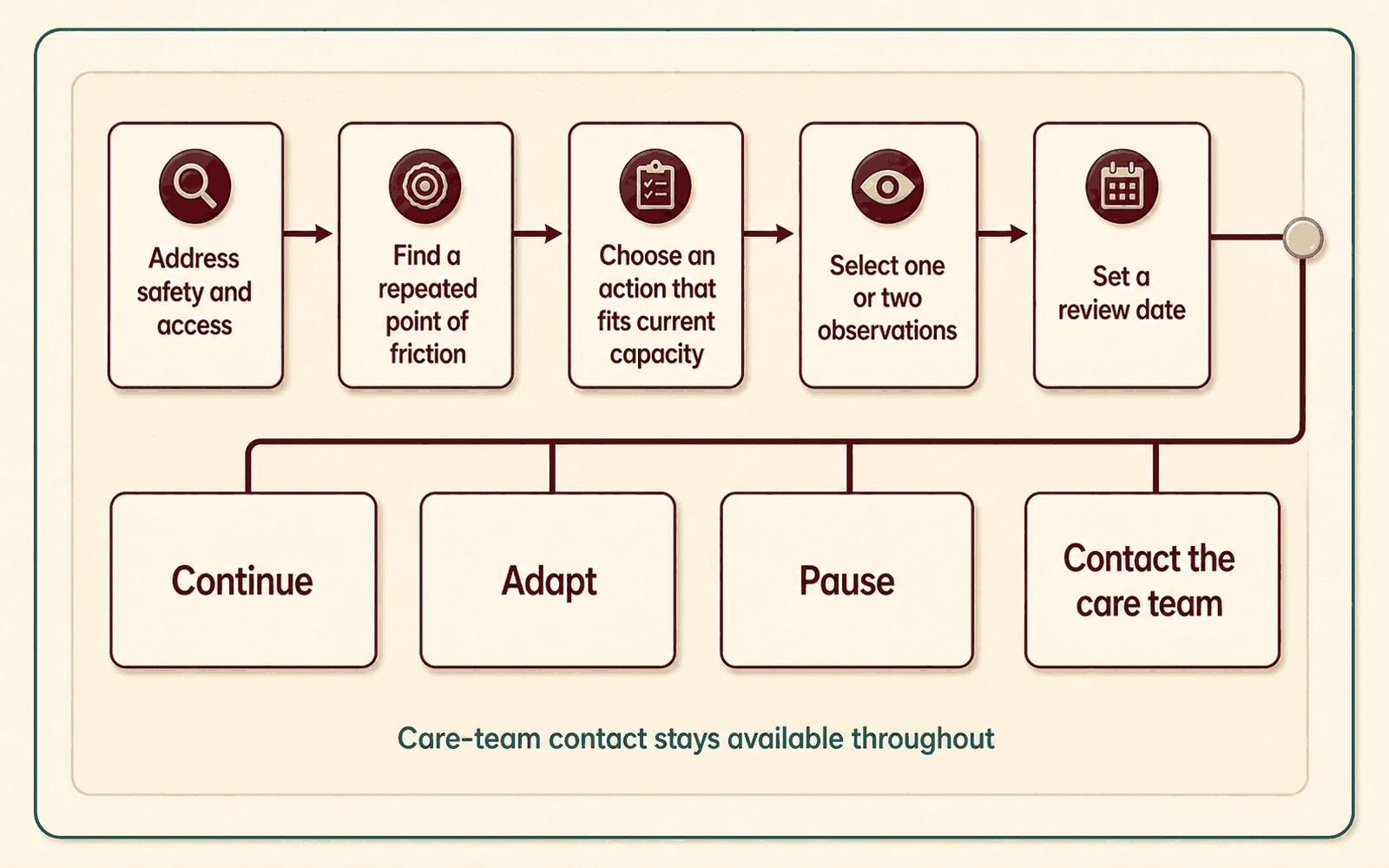
A useful first step has a reason, a realistic action, and a date for looking again. Try this sequence:
- Address safety and access. Follow your safety plan and seek urgent help or contact the care team when indicated. Ask for help with access barriers before adding a planned experiment.
- Find a repeated point of friction. Look for a moment that keeps making the day harder, such as a late work break, a refill obstacle, or a bedtime that shifts with the schedule.
- Choose an action that fits current capacity. Make the action specific enough to try and flexible enough to survive an ordinary week.
- Select one or two observations. Record the information that can answer the current question, then leave the rest alone.
- Set a review date. Continue, adapt, pause, or contact the care team based on feasibility, patterns, symptoms, and clinical guidance.
For the caffeine example, the action might be moving the last coffee earlier on workdays. The observations could be last-caffeine time, bedtime, wake time, and next-afternoon alertness. Keep the record small. Withdrawal, dose, sensitivity, stress, shift timing, and sleep disorders can all affect what you see.
Two weeks can work as a review date for that experiment. Habit automaticity follows a much wider timeline. A 2024 systematic review of habit formation found wide variation across people and behaviors. Individual estimates ran from days to many months. Reviewing earlier gives you a chance to improve the plan before waiting for a habit that may be poorly designed.
A review may show that the action was too ambitious, the observation was noisy, or a clinical question needs attention. Revising the action, measurement, or source of support is a normal use of the framework.
At the check-in
The useful information is what changed and what you now understand better.
Review trends alongside the days that produced them. Compare measurements with your felt experience. A glucose reading, a symptom, or a short log rarely identifies cause by itself. Bring repeated lows, persistent symptoms, medication questions, and any mismatch between the numbers and how you feel to your care team. Then decide whether to continue, adapt, pause, or seek more help. Your observations, barriers, and remaining questions give the next decision a clearer starting place.
Sources and further reading
- ADA Standards of Care 2026: health behaviors and well-being
- ADA Standards of Care 2026: glycemic goals and hypoglycemia
- Galizzi and Whitmarsh: behavioral spillover review
- Silva and colleagues: multiple health behavior change interventions
- Khalsa and colleagues: interoception roadmap
- Gardiner and colleagues: caffeine and sleep
- Singh and colleagues: habit-formation timing
- NHTSA: drowsy driving prevention
This information is for educational purposes. Discuss changes to your diabetes management with your care team.